Asian Wings Cafe

I feel ignored, deprived, and somewhat a little disrespected.  By this, I am expressing a common sentiment felt by the residents of my county, Prince George’s county, MD, a nearby suburb of Washington DC.  As the richest county in the country where minorities make up the majority, PG (as we call it) has not seen as many businesses, investments, and high-paying jobs as in the neighboring Maryland and Virginia counties.  In addition, another area that is glaringly lacking is the number of good ethnic restaurants that heavily dot the other suburbs.  I always have to trek quite some distance to meet my Friday night dinner group in order to savor good ethnic cuisine in Washington DC, Northern Virginia, or other Maryland counties.

The one and only full-fledged Thai restaurant in PG county has been in operation for quite a few years.  However, it is located even further away from me in the neighborhood of Fort Washington, Southern MD.   So, when I came across another Thai restaurant that was closer to me (only 15 mins drive) a few weeks ago, I was thrilled and very eager to give it a couple of visits before writing this review.   Stumbling across Asian Wings Cafe occurred only by happenstance.  I was meeting an old friend of mine, a casualty of the current depressed economy, for brunch at IHOP in his neighborhood during the weekday.  After the meal, I was walking back to my car and I noticed a sidewalk board with names of familiar Thai dishes written on it.  I quickly stepped in the place, had a quick look at the display menu, and left with a take-out copy.  I could not wait for the weekend to head back and check it out.

Sunday came around, and I chose to visit Asian Wings Cafe for lunch with a couple of friends.  It is located in the middle of a rather nondescript strip mall just off the Beltway in New Carrolton.  Across the street from it are sad-looking all-you-can-eat Chinese buffet joints.   It is easy to pass by this cafe without noticing its presence at all, nor does a take-out cafe filled with only four tables brings about the sense of high expectation.   With these thoughts running through my mind, I was not very sure what I was going to expect from this eatery.

The menu here is quite extensive, consisting of fried wings, ribs, noodle dishes, hot wok dishes, vegetarian plates, fries and coleslaw, and a good number of Thai dishes.   With so much to choose from, I decided to narrow my choices to what the place touts itself for – Thai food, fried wings and ribs.

Garlic Fries & Thai Spring Rolls

After a brief discussion with the owner, a young Thai lady who hails from Bangkok, I placed my order upon her recommendations.  I started with the Thai Spring Rolls appetizer.  It arrived at the table piping hot along with some complementary Garlic Fries, which the owner claims are very popular here.  The spring rolls are sheets of thin crispy dough (thank God, not the thick nasty eggroll skin) covering a tasty stuffing of carrots, cabbage, and bean threadnoodle.  These nearly greaseless batonettes, served with its usual accompanying sweet sauce, were as good as those I have tasted in larger Thai restaurants.  The garlic fries had the similar skilful treatment in the hot oil, and they were covered with specks of chopped garlic and parsley, which elevated them beyond their usual guise.  A good start indeed.

A bowl of Shrimp Tom Yum Soup came next.  It was satisfactory but not quite as fragrant as I have had in other places, since it seemed to be missing the usual aromatics of lemongrass and lime leaves.  The use of fish sauce was a bit too heavy, which the owner said could be easily adjusted in the kitchen.  However, the soup had the right spice kick, sweet plump shrimp, and a handful of straw mushrooms, good enough for me to order it on any given winter’s day.

Asian Chicken Wings

I decided to try the fried wings that the cafe is known for.  These small chicken wings, not the Buffalo-sized ones, had a light coating of batter and were fried golden-brown.  One bite into them immediately raised my eyebrows.  The chicken was crispy on the exterior yet moist in the inside, well-seasoned throughout, and had only a hint of grease to the touch.   My dining partner, who has travelled extensively to Thailand, was also amazed by these bites, and he exclaimed that these tasted like those he had eaten in Thailand.  The 14 types of dipping sauces come in combinations of Honey, Garlic, Spicy, and Sweet and Sour.  For me, these wings were good enough without the sauces, which is a testament of this good eat.

Drunken Noodles

My order of wings came with a side order of Drunken Noodles.  The Drunken Noodles were filled with strips of green and red peppers, chunks of chicken, and leaves of fresh aromatic Thai basil peeking through sheets of wide rice noodles.  Signs of high heat wok searing were evident on the noodles which added to its flavor profile.  The dish had the right heat-intensity (peht) and good amount of garlic, with the noodles well-coated with the salty and slightly sweet brown sauce without any evidence of oil pooling on the plate.  This dish was as good as I have eaten in bigger establishments, and I was smiling after a few mouthfuls – I thoroughly enjoyed it.

Fried Pork Ribs

My friend’s order of Pork Ribs with Honey Garlic sauce shared the plate (well, take-out box) with some Thai Fried Rice.  The meat comes on bite-size rib bones covered in the sweet sauce.  I must admit that I did not initially find the dish appealing.  But upon hearing the complements from him, I tried a couple of pieces and I was slightly taken aback.  The meat was flavorful and quite crispy, and the sweet sauce made the ribs quite irresistible.   The fried rice, with pieces of egg, carrots, peas, and onions, is seasoned with Thai soy sauce, which with its slight fish sauce flavor sets it apart from the Chinese version.   Normally, I would avoid any form of fried rice, especially from a take-out joint, but with this kitchen’s rendition, I could not stop digging my fork into my friend’s plate, which probably annoyed him slightly.

Pad Thai

On my next visit, I wanted to discover more of their Thai standard fare.   Pad Thai is offered by most Thai kitchens but they have become such common fare, to the point that some of their versions are so banal, sloppy in their treatment, and lackluster in flavor that they taste like the Thai version of bad fast food.   So, when a plate of these famous noodles from Asian Wings Cafe landed on my table, I was eager to dig into it due to its high visual appeal.  The dish arrived with the noodles cooked with slivers of roast pork, bits of scrambled eggs, large pieces of pungent green onions, topped with a mound of fresh crunchy beansprouts, and crowned with huge sweet shrimps that were just perfectly cooked and not rubbery at all.  The noodles had the right amount of the sweet and sour sauce with pieces of sweet pickled turnip (usually missing in other restaurant versions) which added that crunchy sweet salty element that made the dish successful.  The sides of crushed peanut and slice of lime on the plate allow the diner to control these extra textural and flavor elements.   I must admit that this was one of the best plates of Pad Thai I have eaten in a long time, and I cannot wait to order it on the next visit.

Crispy Chicken Basil

Another dish on the menu that caught my eye was the Crispy Chicken Basil.  Pieces of lightly battered chicken are cooked in a spicy garlicky brown sauce with sweet onions and peppers, topped with fragrant crispy Thai basil.   The pieces of chicken were not overly battered and remained a bit crispy despite being coated by the wonderful tasty sauce.  The fried basil leaves added more to the dish’s crispy element while bringing more fragrance to the dish.  I thoroughly enjoyed this authentic-tasting dish along with a bowl of aromatic jasmine rice.  The chili heat-level added to its irresistibility and scrumptiousness.
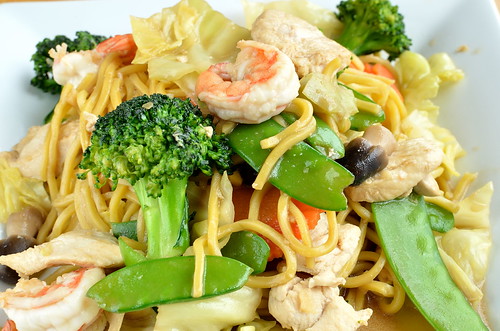
Chicken Shrimp Lo Mein

Throughout my meal I was eyeing an order of Chicken and Shrimp Lo Mein that my friend, mentioned earlier, was devouring with gusto.  Initially, when he placed his order, I chuckled to myself and thought that this was typical farang (foreigner) fare that Americans would order in an Asian take-out joint.  My aversion for this dish is a result of tasting many substandard versions that I have come across in many Chinese restaurants.  Due to its visual appeal and the level of pleasure he seemed to have with the dish, I had to try a couple of mouthfuls of the Lo Mein – this version was an eye-opener.  The noodles were quite fresh and still al dente, mixed in with tender pieces of chicken and shrimp, crispy and barely cooked broccoli, cabbage, snow peas, and carrots, straw mushrooms, covered in a light tasty sauce that was not thickened like others.   I have not enjoyed Lo Mein as much as I did with this order, and it is definitely worth considering in future visits.

Fried Banana Dessert
A complementary order of Fried Banana Dessert was delivered to my table after I finished my savory dishes.  Pieces of sweet ripe banana are wrapped with thin spring roll pastry, greaseless from the kitchen’s usual skilful hot oil frying, and topped with honey and fragrant sesame seeds.  These small sweet bites were just the perfect and quite a surprisingly good dessert to end the meal.

Asian Wings Cafe is not your run-of-the-mill neighborhood Asian take-out joint despite its unassuming outside appearance.  Its strengths lie in the knowledgable kitchen that is capable of producing good authentic Thai dishes alongside its perfectly fried and tasty wings and ribs.   The cafe just celebrated its second anniversary a couple of weeks ago, and it seems to have established itself firmly in the area judging by the friendly customers that I saw coming and going during my visits.  I will be a regular customer due to its close proximity to my home and the delectable dishes that I have enjoyed there.  Welcome to Prince George’s County, and I am sure that your wonderful food will be the real reason for a long stay in our neighborhood.

Asian Wings Cafe on Urbanspoon

I Ricchi

Living in different countries and continents, my family has always had a challenging time figuring out a city for us to come together in order to spend time with each other. The last time that all my siblings and parents managed to convene in a single place was 2006 in the most central point between Australia, Malaysia, and the USA – Hawaii. Ironically, it took less time for my folks in Australia to get there than my travels from Washington DC; a missed connection even further extended my trip to around 18 hours long!

So, last year, when my cousin, living in London, invited the family to her summer home in Tuscany, Italy, most of us jumped on the invitation without any hesitation. It was a great opportunity for my sisters’ families, me and my parents to catch up with each other, and for us to savor the Italian experience. This has always been a dream of mine to travel to this part of the world for its amazing scenery, architecture, fine arts, and culinary arts. The 11-day trip through the Tuscan countryside and stay at Volterra exposed me to its glorious cuisine that gave me a new perspective on Italian food. It was this foodie’s dream come true and a trip worth a thousand bites.

Being an online restaurant coupon junkie, I sometimes am tempted to buy as many offers that show up in my inbox. But when two sites advertised such discounts for the upscale restaurant I Ricchi, I did not have the slightest hesitation in clicking the “buy” button as I had heard about this reputable place for many years but had never visited it, despite both of us arriving in DC at the same time in 1989. With a newfound appreciation for authentic Italian cuisine, I knew I could not forego these opportunities, and it was time for me to visit the Italian restaurant to re-live my Tuscan trip.

House-made Foccaccia
Entering a high-end restaurant with impeccably looking staff such as I Ricchi can sometimes be a bit unnerving and maybe intimidating. But upon stepping into the foyer, there is a slightly relaxed charm about the place that is quite devoid of stuffiness. The front desk staff were nice and amenable to me, especially after I requested a well-lit table for my photography. My waiter, Justin, was professional, warm, and personable, and he was quick to put me to ease with his charm and knowledge of the menu. Right then, I knew I was in good hands and ready for a wonderful culinary journey. A basket of house-made slices of rosemary-topped and tomato-topped focaccia with large sea-salt granules immediately transported me back to Levanto where I stood in line for 30 minutes for this freshly-baked bread (which was truly divine), and this restaurant’s version was superb. The journey had already started with the first wonderful bite.

Truffled Polenta and Balsamic Mushrooms

I decided to “travel” on these Tuscan dining experiences (two visits in a week) the Italian way by ordering my meal in various separate courses, very much like how it is done on the Continent. On my first visit, for the antipasti course, I ordered the day’s special of Truffled Polenta with Mixed Mushroom (Polenta Tartufata ai Funghi Farciti). The heady scent of truffle oil in the soft rich polenta cake was delightful from the first mouthful, which quickly brought me back to Volterra where I had a heavenly dish of Ricotta gnocchi topped by a tall heap of truffle shavings.   Surrounding this cornmeal mound was a melange of sautéed portabello and porcini mushroom that had been deglazed with Balsamic vinegar. It was a very satisfying dish but after some time, I could not detect the delicate truffle scent once it was overwhelmed by the sweet and oaky vinegar. I had wished that its dark glaze was drizzled around the dish which would allow the diner to control its level of intensity in relation to the truffled polenta. However, such detail did not deter me from wiping the dish clean.

Orange, Fennel, Arugula & Pecorino Salad

A Salad of Arugula with Orange, Fennel, and Pecorino Cheese (Ruccola con Aranche e Pecorino) was the opener on my second trip. The peppery arugula leaves were tempered by the sweet orange segments and slivers of shaved pecorino cheese that added a smooth nuttiness to the biting greens. It was a well-made salad that was balanced by the different strong elements on the plate. I nearly forgot about the very thin fennel shavings that seemed to be missing the anise-like flavors for I suspect they had been macerated in lemon juice, which mellowed them out – this missing flavor dimension would have given the dish that extra touch. Nevertheless, it was definitely worth ordering this classic Tuscan Salad.

Ricotta Spinach Tortelloni and Sage Butter Sauce

For the pasta course, I ordered the Tortelloni in Sage Butter Sauce (Tortelloni al Burro e Salvia). This is another classic with large-size tortellini made from thin fresh pasta filled with a savory mixture of Ricotta cheese and Spinach. The sage scented butter sauce was the perfect accompaniment to the delicate pillows. The hint of lemon juice in the sauce was the right amount of acid to cut through the rich butter and Ricotta. The pasta was cooked al dente the Italian way which tends to be firmer than what we over here prefer it to be. Maybe a minute more in the boiler would have been perfect for my taste, but the stuffed tortelloni dish was just the right pasta course.

Papardelle with Rabbit Ragu

On the next visit, I decided to go for a dish that was similar to a wild boar pasta dish I had eaten throughout my Tuscan trip – Fresh Pasta with Rabbit Sauce (Pappardelle Sul Coniglio). Wide ribbons of egg pasta were covered with a tomato-based sauce, which was cooked with aromatics of sweet carrots, mellow onions, and pungent celery. Chunks of tender rabbit meat enrichened the ragu that was paired with the wide and delicate pappardelle, whose broad width added to the dish’s heartiness. I could not help but relive the sense of satisfaction similar to eating the Italian wildboar version as this restaurant’s offering did conjure up the same flavors on my taste buds – another successful classic pasta dish that I could eat more of!

Grilled Steak, Red Onion Rings & Truffled Spinach

The Tuscan countryside is reknowned for its high quality meats that end up on the table as main courses or cold cuts. With this in mind, I focused on such offerings during my two visits. The day’s special offering of Grilled Steak with Onion Rings and Truffled Spinach (Bistecca al Ferri con Cipolle Fritte e Spinaci al Tartufo) caught my eye on the first visit. The steak was perfectly cooked (medium-rare) and it was juicy due to its heavy marbling. Its stay on the firewood grill gained a level of smokiness that reminded me of the humongous Bistecca Fiorentina that I savored in Volterra. The choice of red onions for the Onion Rings added an unexpected sweetness in this obligatory side order. The truffle oil in the sautéed spinach added a nuttiness and je ne sais qoui that elevated the dark greens. This steak may not be the superlative Chianina beef that I tasted in Italy, but it sure was close to it judging by what was left on the plate.

Lemon Rosemary Lamb Chops

Costolette D’Agnello a Scottadito was my meat course on the second trip. It is grilled lamb chops marinated in lemon and rosemary. The thick tender pieces of lamb had a rosemary scent that cut through any “gaminess” that this meat could sometimes exude, while the hit of lemon juice further mellowed the rich lamb. The first bite took me by surprise with a citrus jolt that hit the taste buds first. But upon chewing the meat, the various elements mixed rather harmoniously into a tasty bite.  A fried polenta cake and some broccoli with shiitake mushrooms were satisfactory sides to the meat.  Another successful meat course on the menu with this dish.

Walnut crusted Cheesecake

An Italian dining experience would not be complete if one did not have a few bites of Dolci or Italian dessert. The menu has the recognizable offerings of Tiramisu, Biscotti, and Gelatos. Even though there was not much room left for this final course, I ended up with the house’s version of Walnut Crust Mascarpone Cheese Cake (Torta Di Formaggio). It is a lighter cheesecake whose crust, made with bits of walnut, sets it apart from others. A light sauce made up of pieces of strawberry macerated in lemon juice was the right partner that provided enough sweet citrus hit to cut through the cake’s richness. It was difficult to put my fork down despite the level of satedness I was already feeling.

I Ricchi serves a clientele that comprises of DC bigwigs and members of the diplomatic and politico communities. And such clout and the restaurant’s well-established reputation are reflected by the not-so-modest bills that I received at the end of my meals. But this restaurant offers, in my estimation, an excellent authentic Italian culinary experience that is worth your money. This is not your everyday eating joint, but one which is worth visiting once in a while, especially when the urge to travel, either first time or a subsequent trip, to Italy is itching within. This foodie’s restaurant visits were quite worth the money spent, and they sure beat the price of a round-trip ticket to Europe, if only for a short moment, until the sense of wanderlust for Italia returns again.

I Ricchi on Urbanspoon

Maruko Japanese Restaurant

The 11th day of August is an auspicious day that is well-embedded in my memory.  It is not a national holiday, a birthday, or an independence day – it is my parents’ wedding anniversary.  Every year, I am duly reminded of this date by my parents who will drop hints when I get a call from them a week or a few days before the day itself.  My parents view this date with the utmost importance, and the same expectation is expected from their children.  Forgetting to call and wish them on the 11th would warrant a slight chiding or an email stating, “You forgot Daddy’s (or Mummy’s) wedding anniversary”, depending who was the sender dropping the not-so-subtle reprimand.

To celebrate the occasion, my parents would take the family out for dinner, and their favorite place to mark the occasion was usually an elegant Japanese restaurant in a top notch hotel.  Growing up in Malaysia, Japanese cuisine was served primarily at high-end Japanese restaurants, and a visit to one was usually an elegant and fascinating dining experience, which at the same time exposed me to this rather exotic far-eastern cuisine at an early age.  These were the days before the proliferation of Sushi bars and Teppanyaki grills, which later became abundant and fashionable in major cities.   To reflect the special event that we were celebrating and to match the refined and exquisite ambience surrounding us diners, my siblings and I would dress up in our finest outfits – this was definitely no ordinary everyday dining experience.

With Sushi bars abound and Japanese restaurants everywhere these days, this type of cuisine is very accessible and has become well-appreciated by many.  My early experiences with Japanese food in Washington DC can be characterized and range from expensive but well-cooked food to inexpensive but rather inferior quality.   With a great number of these restaurants these days, competition has raised the bar, and as customers, we have started to expect more.

Maruko Japanese Restaurant has been located on a long strip dotted with some good restaurants (blog on Bangkok 54) in the neighborhood of Arlington, VA, for as long as I can recall passing down that road.   In its earlier days, it went by the name Matuba, but I suspect that a new ownership brought about the name change.  The realization of its new sign was as subtle and seamless as in the change of management, and the cooking has not suffered many bumps, if hardly at all, during this transition.

Squid Salad

Gyoza/Pot Stickers
Usually, I would forgo ordering appetizers here since I know that the main course is rather substantial for me, especially at this age of a slowing metabolism and trying to lose some weight from all this food blogging field work.  But I was feeling rather famished on one visit, and I decided to order an appetizer that was not my usual fare.  The Squid Salad was abound with strips of squid, sitting on a lettuce salad, and topped with a daikon radish, ginger, and miso salad dressing.  The strips of squid took me by surprise with their sweetness paired by their tenderness in each bite I took.  The dressing was the perfect accompaniment in this seafood salad with its slight sweetness and muted ginger-bite.  An order of Gyozas or pot stickers was tasty and good, but nothing different from what you could expect from a good restaurant.

Sushi/Teriyaki Combo 1

Sushi/Teriyaki Combo 2
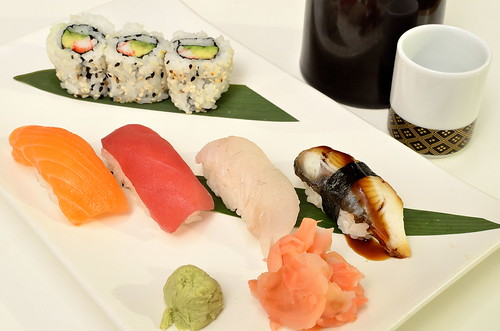
One of my favorite fare here is The Teriyaki Chicken and Sushi Combination, a mixture of the hot and cold, the raw seafood and cooked chicken.  The thigh meat comes with its skin slightly charred from the grill, and it is slathered with a lightly sweetened sauce.  The other half of the order is a plateful of sushi (tuna, salmon, yellow tail and eel) and pieces of California roll.  The dish represents the best of both worlds in terms of textures and flavors, and it is quite hearty and satisfying on these levels.  A bowl of well-made miso soup as an opener is filled with slippery seaweed (wakame) and spongy bits of tofu, which whets one’s appetite for what is to come.  For less than $13, this combination is a great deal and a winner.

Sushi/Sashimi Combo

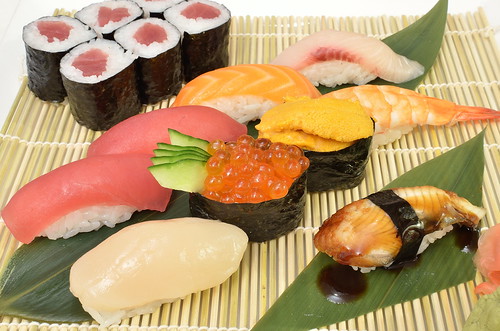
During the summer, I tend to order the large Sushi/Sashimi Combo that consists of pieces of Sushi made with Tuna, Salmon, Eel, Yellow Tail, Shrimp, and Squid, pieces of California Roll, and purses of Salmon Roe and Sea Urchin.   The dish is a feast for the eye and for one’s hungry stomach, and seafood freshness is notable here for the most part (the piece of squid was a bit too slimy for me but still edible  – perhaps a textural issue for me).   The sushi rice is cooked and shaped perfectly that they do not fall apart in the chopsticks, and it complements the seafood pieces mild ocean sweetness.  The Salmon Roe and Sea Urchin purses are bursting with a slight brininess that reflects their freshness and rich unctousness.   This dish is definitely a raw fish delight.  A friend’s order of Grilled Sea Eel (Unagi Donburi) looked great with large pieces of fish covered with a light sweet sauce sitting on a bed of rice.  However, my friend was slightly disappointed by that day’s meal as he claimed that he had had a better dinner there with that dish.

Spicy Tuna Roll

During my meal, our friendly waitress urged me to take a couple of photos of dishes coming from the Sushi Bar that looked delectable and irresistible.  One was a Spicy Tuna Roll that was not your typical version; this restaurant makes it with soya bean skin which I have never seen before.  The other dish was a Tempura and Crab Roll topped with flourescent red and green flying fish roe.  Even though they were not our orders, the visuals were so tempting for me to perhaps order them on the next visit and definitely when the weather gets warm enough.

Tempura Crab Roll

Maruko serves the customer delicious and fresh Japanese cuisine at a very reasonable price.  In time and with various restaurant visits, I have developed a sense of trust and dependability on its cooking and the freshness of its seafood, much like having one hairstylist that you would allow to have free rein with.   It is definitely one restaurant worth returning to time and time again, like the one my parents would take us to yearly for many years.  This place is surely Oishi, or good eats.

Maruko Restaurant on Urbanspoon

Lunar New Year Celebration

Over the past weekend, I held a dinner to mark the end of the fortnight-celebration that brought in the Lunar New Year. Being the Year of the Dragon, it is considered a very auspicious year, and it is my oldest brother “anniversary”. This year, the Lunar New Year commenced so close to the Gregorian New Year that I could not get myself ready in time to have a dinner gathering at the end of January – all I could muster then was a quick meal of 3 dishes with a couple of friends on the eve of the New Year.

The New Year celebration is a time for family members to travel back to the family home in order to spend time together. The Reunion Dinner, as it is known, is held on the eve, and it is considered imperative that all members are present at the dinning table for such meal. With half of my family members living in Australia and the other half on the West coast, Midwest, and I on the East coast, such gathering is close to impossible with our busy lives, let alone the long distance in between my siblings and parents. The last time our whole family came together for the celebration was just before I left home for high school in England when I was just 13 years old.

For the meal, I decided to prepare a few of my grandmothers’ Nyonya dishes. Nyonya is the term given to the women of the Peranakan culture, a hybrid culture that formed as a result of Chinese men migrating to tropical Southeast Asia, beginning in the 15th century, and marrying the local women folk. It can be considered the first mixed culture whose beginnings predates the arrival of the Spanish to the Americas and the formation of the Spanish mestizo culture. My grandmothers were truly amazing cooks, and I was blessed to have spent a lot of time with them in the kitchen as a child suffering from migraine headaches as a result of sun exposure – the kitchen became my refuge and daycare center. I grew up watching all food-related activities, smelling the cooking, handling all the ingredients when I was put to work, and tasting all the dishes before they ended up on the dinner table. Each nightly meal consisted of at least 8 dishes that were made from scratch, beginning from the early morning visit to the open market. Preparing dinner for a Peranakan family was always a tall-order that had no room for error – all partakers would sit down with great anticipation, high expectations, and a well-honed critical palate.

Yee Sung/Lo Hei ingredients

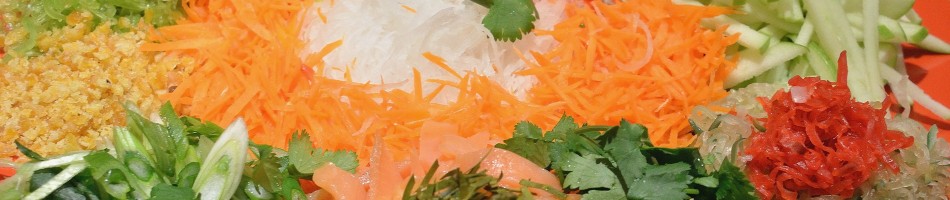
As the starter for my dinner celebration, I decided to offer a Malaysian-Chinese tradition that is both unique and delectable. Yee Sung or Lo Hei is a vibrant raw fish salad that consists of pomelo (like a sweet grapefruit), apple, raw fish (which I substituted for smoked salmon), jellyfish (which I omitted as to not weird my friends out), candied fruits, different spices like cinnamon and five-spice powder, a wide variety of Chinese pickles, aromatics like Kaffir lime leaves and cilantro/coriander leaves, shaved daikon radish, shaved carrots, sliced fresh chili, peanuts and sesame seeds, fried wanton-skin strips, and topped with sauces like plum sauce and fresh lime juice – a total of 25 ingredients in all! According to Wikipedia, this dish was created in 1952 in Malaysia, and it is an adaptation of a Southern Chinese tradition in which fishermen would celebrate their catch on the 7th day of the New Year.

"Lo Hei" -Ready, get set, go!

"Lo Hei" - Tossing Prosperity

Following customary practices, all my guests gathered around the well-assembled plate of ingredients, and with their chopsticks, they tossed and mixed the different elements together while shouting out “Lo Hei” which means “Tossing Prosperity”. The idea of such an act is to attract and invigorate the energy of prosperity and good fortune to one’s life for the year. Although foreign to my American friends, they enjoy this activity with great enthusiasm and the salad with savoring mouths, and they look forward to this interactive and playful dish at every New Year’s celebration.

Preparing the main 4 courses was quite a daunting task. If were not my local Korean grocery store, I would be running around the city trying to find the fresh ingredients that were necessary and prominent in the dishes’ flavor profile. I had spotted the pomelo for the appetizer dish a couple of weeks before hand, and I grabbed it when I saw that it was at the right level of ripeness – storing it in the fridge was necessary to preventing it from spoiling. I bought a fresh pineapple for two of the main dishes a week before, and I chose the ripest looking one and further ripened it on my kitchen counter until its scent of sweetness was oozing out of its tough skin – these were necessary steps taken by my grandmothers for assuring success in their cooking, and I was just following their finickiness for such details. I managed to find shallots, fresh lemongrass, fresh turmeric, wood fungus, beanthread noodle, coconut milk, chili paste, shrimp paste, peanut brittle, lily buds, and the various different sauces all under one roof. I love my Korean grocery store!

Shrimp & Pineapple Curry

Spice Paste for Shrimp Pineapple Curry
Just preparing the spice paste for Shrimp and Pineapple in Coconut Sauce (Udang Lemak Nenas) took around an hour. It is the main flavor base of this rather intriguing and complex dish – the list is rather long consisting of 8 roots and aromatics. In addition to this base, the sauce is made up of coconut milk, dried fish, and tamarind juice, to which large sweet shrimp and chunks of fruity pineapple are added. As disparate shrimp and pineapple are and an unlikely pair, it is this rich and full-flavored sauce that becomes their liaison like a good matchmaker. For me, this was the most challenging dish to make due to its complexity and list of fresh spice ingredients, and due to this fact, I recreate this dish probably only once every three years. However, it was worth the effort judging by the complements that I received from my guests who savored it with gusto and satisfaction.

Chicken Pongteh

Shallots and Garlic for Pongteh
Chicken, Chinese Mushrooms, and Potato Stew (Pongteh) is one of the most recognized Nyonya dishes by those familiar with the culture. The ingredients are stewed in a sauce that consists of copious amounts of crushed shallots and garlic, which is then flavored by a brown bean paste. I had cooked the dish the night before until the chicken was about to fall of the bone, and I allowed it to soak up the savory sauce overnight. This dish is standard fare in all Peranakan home dinner tables especially during festive days. It was served with the obligatory hot sauce of chili paste, fish paste, and lime juice (Sambal Belacan); this chili mixture adds a contrasting spiking spicy citrus element to the mild-flavored chicken. The stew was well-received by many guests for its subtle yet soulful flavors.

Cucumber Pineapple Salad

To complement the above dishes, I made a couple of side Nyonya dishes. The first was a simple Cucumber and Pineapple Salad (Sambal Nenas Timun). In addition to the fore mentioned ingredients, the sauce consists of chili paste, dried shrimp, salt, shrimp paste, and an odd ingredient – crushed peanut brittle. The fresh ingredients are spiced up by the chili concoction, slightly brined by the dried shrimp and shrimp paste, and the peanut brittle brings notes of rich nuttiness and caramel sweetness to the dish. I have prepared this dish often since it is quite easy to put together, and it is a favorite at many of my dinners. As usual, it did not disappoint my guests this time as there was not much leftovers at the end of the meal.

Chap Chai

The other side dish was a melange of Cabbage, Beancurd skin, Beanthread Noodles, Lily buds, and Wood Fungus in a garlic and fermented beancurd sauce (Chap Chai). This recipe is the closest that identifies the Peranakans as Chinese immigrants, even though they are centuries removed from the motherland. The various ingredients are purely Chinese and one has to seek out these imported ingredients to make the dish successfully. Many of my guests exclaimed how much they enjoyed the dish especially the slippery and slightly crunchy wood fungus, which I found it to be odd and amusing!

After such a rich and wide offering of dishes, I decided to make dessert simple – Fruit Cocktail. However, it was not just your plain old fruit cocktail but one with a Chinese and Southeast Asian twist. I opened cans of Lychee, Rambutans stuffed with Pineapple, Jackfruit, and Almond Jelly. Just as in most Asian desserts, the accompanying syrup was not cloying sweet, and there were only a few ladleful scoops left by the end of the meal. It was just the perfect ending.

The end of the Lunar New Year, called Chap Goh Meh in the Peranakan culture, was an ocassion in which one used to parade an unmarried daughter to potential eligible suitors in hope of securing a well-matched marriage. The end of the fortnight was also a time to have one last festive bang before resuming daily life, hoping for a fortuitous year. I was glad that I could share my treasured grandmothers’ dishes with my close friends and continue the tradition of Lo Hei. I only wished that I had more hands in the kitchen just like how my older relatives would come together for a couple of weeks in preparation for the New Year. Perhaps I should have also thrown in a session of speed-dating for both my hopelessly single straight and gay friends, much like the Chap Goh Meh, in hope of finding them a suitor for the New Year. But, there is so much I can do for them, especially when one is cooking a monumental Peranakan dinner like this one! Maybe they should have matched me with someone special for all the effort that I put into and the dishes that my guests stuffed themselves with that night. The Peranakan saying that a young lady’s marriage worthiness is reflected by the skillfulnes of her cooking should still hold true to this day and to anyone, either female or male, as it is in my case!

Addendum 2013:

CNY 2013 027.jpg

For this year’s celebration, I was out of the ingredients for the Lo Hei/Yee Sang salad featured above since I did not have the various pickles and ingredients that my mother would usually send to me during to her trips here. In lieu of that, I decided to make a dish that hails itself as the only appetizer found in the Peranakan/Nyonya cuisine – Kueh Pie Tee or fondly known as Top Hats. To make the shells, I needed a brass mold that I had not picked up in over 10 years. After heating it up in some hot oil, I dipped it in a pool of thin rice and flour batter, and return it into the oil to fry as the top of the shells spreaded out, hence its moniker Top Hats. I must admit that it was rather time-consuming since it took me around 2 hours to make around 45 shells, knowing that my guests would scoff down an average of three even before the main meal.

DSC_3121.jpg

As the stuffing, I had to hunt down some Jicama root, as known as Bangkuang in the Peranakan dialect. For many years, I would find them in the local Mexican stores, and this piqued my curiosity about its origin. After doing some research on Wikipedia, I discovered that the root vegetable is indigenous to Mexico, and it was brought over by the Spanish conquistadores to the Philippines, one of her colonies, before it spreaded in Southeast Asia. The Pie Tee stuffing consists of the shredded and dry-squeezed Jicama, diced chicken breast, and diced shrimp. What elevates these ingredients and ties them together is a sauce made from garlic, fermented bean sauce, 5-spice powder, soy sauce, and white pepper. Along with this mixture, the crispy shells are stuffed with fresh lettuce, and topped with egg strips, fried shallots, and a dap of tangy chili sauce. A single mouthful of this dish is a study of contrasting textures and flavors, all coming together to make it a truly satisfying bite. Watching my guests enjoy these stuffed shells made it worth while standing at the stove for those couple of hours.

DSC_3141.jpg

Another dish that I made for the occasion which I had not made in some time was my maternal grandmother’s pickles – Achar Ahwak. Since it was a pickle dish, I had to make it in advance, and the process was quite laborious. I had to salt pieces of sliced cucumber, squeeze the water out, then dry them in the oven for around 1 1/2 hours until the pieces were dry and shriveled. Traditionally, these pieces were placed in the hot sun until the right dried state. Along with the cucumber are pieces of carrot, longbean, red chilies, and large ribbons of cabbage, all parboiled and squeezed dry. The pickling sauce consisted of tons of shallots, a bit of fresh turmeric, dried chili paste, white vinegar, salt, sugar, and a touch of sesame oil. What makes this pickle unique is the addition of a copious amount of crushed Peanut/Sesame Brittle that added the rich nuttiness as well as the necessary sweet element to compensate for the acidity. My grandmother would make a vat full of this and we would scoop a bowl full every night for our dinners until we ran out of it. Similarly, I made a large bowlful, and I’m still enjoying the remnants to this day, weeks after the celebration dinner. It truly was worthwhile and an honor to recreate my grandmother’s dish and to maintain this tradition alive.

Watch: Click on the following link to view a brief video on Peranakan Culture – Click here

Bangkok 54

You can say that I have had my fair share of Thai food in my lifetime.  Having spent the earlier part of my childhood growing up south of the border (Thailand’s, that is), I was introduced to this exotic Southeast Asian cuisine at a very early age.  Although it resembles my home cuisine in many ways, there are distinctive differences that I learned to discern and appreciate with time.   During my early days, Thai restaurants were still quite rare even though I was growing up in that region of the world.

These days, you could not stroll down a few blocks of a metropolis without coming across at least one Thai restaurant.  In the Dupont Circle area of DC, you can find at least 4 of these restaurants within a quarter-mile radius.  A stone throw away in Arlington, VA, I could drive down Columbia Pike and hit at least 3 of them within three minutes.  When I was living in Sydney, Australia, in 2008, there was at least one Thai restaurant in every corner of its downtown area, and nearly the same density in some rather affluent suburbs.  As the saying goes, you could not avoid them like the plague.

So, with the abundance of this Southeast Asian cuisine in the Washington DC area, how does one know if the restaurant is serving authentic and good eats, and is worth visiting?  I would say that the answer lies in the fine details and in the gestalt, the totality of the dining experience.

Bangkok 54 Decor

Bangkok 54 is one of those locales on that 3-restaurant strip in Arlington.  It has been around for quite a few years and over time I have dropped in there a number of times.  The business was originally a Thai market that sold delicious home-prepared foods to its customers.  In time, it bought over its neighboring lot and renovated it into a swanky Thai bistro.  It was one of the first Thai restaurants that I could recall having a modern interior while serving authentically based food – you can find both classic dishes, along with some updated versions of Thai traditional fare.  Being a bit of a purist, I decided to taste a myriad of typical dishes and evaluate them as the barometer of its kitchen’s cooking.

Hot and Sour Shrimp Soup 2
A good measure of a Thai kitchen is its rendition of the classic hot and sour soup, or Tom Yum.  Although it is a strong-tasting and aromatic soup, there are some finer points to a well-made bowl.  The secret is in the broth that is spiked with citrus lemongrass, rooty and camphor-like galangal, aromatic kaffir lime leaf, biting chili paste, sour lime juice, salty fish sauce, and the addition of a bit of sugar to round of the disparate elements.  The restaurant’s version does some justice to this well-known soup that is filled with plump sweet large shrimp and floating pieces of button mushroom.  The floating chili oil slick on its surface attests to the spice level that the kitchen does not seem to shy away from – Peht, as they say.

Minced Chicken Salad
On one visit, I decided to order a couple of appetizers as my main course.  Larb is a minced chicken salad that has been seasoned by lime juice, fish sauce, red onions, and roasted chili flakes, with a faint hint of sesame oil and served on a bed of lettuce.  It has quite a fiery bite that is tempered by the sauce and the cool lettuce that serves as its edible bowl.  This is not your mother’s chicken salad as it will take you to another place and taste level with its unequivocably strong flavors.  Love it.

Bean Noodle Salad
Yum Woon Sen was the other partner in crime.  It is a shrimp, chicken, and beanthread noodle salad that has been seasoned with lime juice, fish sauce, red onions, and fresh red chilis.  The pieces of chicken were more moist than the previous appetizer, and the beanthread noodle provided a textural difference while having absorbed all the yummy pungent sauce.    I could not help but slurp down all the flavorful noodles with pure satisfaction.

Pad Kee Mao/Drunken Noodles
On a recent visit, I decided to order a couple of standard entrées.  On my way out on my previous visit, I had spied on a noodle dish that was coming out of the kitchen, which made me vow to order it on the next visit.  Pad Kee Mao, or the well-known Drunken Noodles, is one of my all-time favorites and it is a must-order when I eat Thai, especially for weekend lunch.  This kitchen’s rendition comes with a choice of different meats or seafood, and I decided to go full gusto – I went for the seafood combination.  The plate arrived with glossy wide rice noodles that have been well-coated with its slightly sweet brown sauce without any excess grease pooled on the plate, with large chunks of tender squid, shrimp and huge sweet scallops barely hanging on to the noodles as if they are about to roll off a mountain – this was truly a seafood delight.  I relished every strand of noodle with the obligatory splash of vinegared green chili condiment that came in a flourescent-red basket.   I was in noodle heaven.

Pad Phrik Khing
Pad Phrik Khing is a dish of few ingredients, comprised of a choice meat, fresh green beans and a complex spice mix that makes the dish distinctive.  The flavor base is made from various roots like lemongrass and galangal, spices like cumin and coriander seeds, and aromatics like Kaffir lime leaves.  The dish that I ordered came with large pieces of moist pork, fresh turgid green beans, and a fiery and tasty sauce that pulls the ingredients together.  The use of a bit of sugar not only ties in the different flavors  but also tempers the spice mix that comes close to overpowering the dish.  It is well-cooked but I missed the garnish of thin slivers of fresh Kaffir lime leaves that adds that extra flavor oomph, which I have tasted in other places.  However, that did not stop me from spooning all the tasty sauce onto my bowl of fragrant jasmine rice.

During my meal, I could not help but constantly eye at the dishes served at the next table over from mine.  One of them was a bright orange Butternut Squash in Red Curry, which consisted of a large round of the sweet gourd smothered with a rich coconut-milk based fiery red sauce.  Judging by the effusive complements from the lucky recipients, this is going to be on my order list for the next visit.

The menu here is extensive and covers a wide variety of Thai classics of rice, meat, vegetables, and seafood dishes.  There is also a fairly large vegetarian menu that most Thai restaurants feel obligated to offer as respect for their Buddhist tradition.  What sets the dining experience in Bangkok 54 apart from others is the skillful cooking of its dishes (which one can view into the open kitchen), the fine details in its dish presentation and efficient service (including the waitresses’ neatly pressed modern outfits), and the relaxed yet sophisticated well-decorated ambience (large flower sculpture friezes, recessed Buddha statues, deities, and traditional figurines) that allows the diner to relish on along with some good eats.   Just like its market that has survived this recession while other area Thai markets have folded-up, Bangkok 54 seems to have the recipe for success, and it will be around for some time to ingratiate more hungry mouths with its offering of this wonderful Southeast Asian cuisine.

Bangkok 54 on Urbanspoon

Yves Bistro

After nearly 12 hours on a Spanish train with not one common language spoken among all four fellow passengers cooped up in my couchette cabin, and having just finished a six-month study stint in Madrid, I arrived in Paris in the late 80’s to get re-acquainted with a long-time French friend I met a few years back in college.  Great anticipation was running though me as I was eager to venture into a major city touted for its artistic and architectural beauty and for its renowned cuisine.  To my mild surprise, the trip was both a revelation and a disappointment.  My experiences were marred by an over-priced can of coke ($12) at the Notre Dame (naive tourist like me), an unsatisfying Haute Cuisine salad ($20) that barely sated my appetite (Haute is not that hot!), and mediocre bistro food at the Latin Quarter that catered to poor students (moi included).  The upside of the trip, besides Paris’ sheer beauty, was the discovery of Boulangeries (Delis) in which I would purchase baguette sandwiches filled with tasty cold cuts, patés, and a generous dollop of good grain mustard.  Biting into the crusty sandwiches made me wonder if there was French food that was accessible, reasonably priced, and delectable at the same time.

Upon returning to Washington DC, I visited the long-time Bistro Francais in Georgetown where I was rewarded a few decent meals, especially 3-course Early Bird Specials that came with a glass of wine for less than $20 ($25 now).  I had heard of another local haunt, Au Pied Du Cochon, which was a late nighter in the same area that I never had the chance to visit before its much-publicized demise.  Visits to a few high-end area French restaurants only confirmed to me that they can be stuffy, overpriced, and underwhelming.

Around a year ago, a regular dining companion of mine told me of a French bistro that opened up in the Alexandria, VA neighborhood near the Eisenhower metro station.  He was exclaiming how he enjoyed a simple Mesclun salad with a wonderful Quiche, all for a reasonable price.  Such words from a fellow gourmand propelled me to discover it, and many visits have I paid it.

Soup du Poisson

From the first visit, Yves Bistro has won my heart and appreciation for good French cuisine.  The kitchen’s expertise is evident in their first offering of appetizers.  The French Onion Soup is onion-filled, slightly woodsy from the obligatory use of thyme, and topped with a slice of baguette and gratinéed cheese.  The Fish Soup (Soup de Poisson) is a light fish tomato broth scented with rosemary and dotted with small chunks of moist fish, topped with a slice of baguette drizzled with a rich Rouille sauce.  A menu special of Carrot Soup once proofed to be not too successful as it was rather bland and lacking the root sweetness.  But the kitchen seems to have the menu standards down pat.

Paté de Foie de Canard

The Smoked Salmon, Clams Casino, Mussel stew, and Escargot dishes are fairly good and worth an order.  But the true appetizer stars are the Duck Liver Mousse Paté  and the Duck Leg Confit.  The Paté is rich and fresh, quite heady from generous bits of black truffle studded through it, and complemented by a couple of cornichons and nicoise olives that provide the palate the necessary briny relief from the richness.  The lovely presentation on beautiful Lenox chinaware augments the sense of its lusciousness.

Duck Leg Confit

Although it is listed as an appetizer, I prefer to order the Duck Leg Confit as my main course after not having refrained from the above soups and appetizers.  The slightly salty, crispy yet moist duck leg comes perched on some sautéed spinach sitting on a bed of perfectly cooked Puys lentils.  This is truly a hearty and satisfying dish with tender pieces of succulent duck well complemented by the vibrant greens and the tender legumes.

Yves Salad
Sometimes the simplest dish is a good indicator of a light hand and knowledgeable kitchen, as in the case of the Yves Salad.  It comprises of baby spinach, arugula, friezé, and red leaf lettuce, that are lightly coated with a good french vinagrette, topped with tasty garlic croutons and roasted walnuts.  Simple, tasty, and satisfying – need I say more.

Broiled Lobster

There are some shining stars among the main courses, that is if you haven’t stuffed yourself with appetizers yet.  The classic Trout Almondine is well handled here with a slight butteriness present on the moist fish and flakey almond slivers.  Accompanying it are a veritable Ratatouille and some Alsacian-like sweet sour red cabbage.  Another seafood fare that is quiet popular and a favorite of mine is the broiled whole Maine lobster that is cooked succulent, topped with a simple slaw, and served with a pile of to-die-for Frites (sans le ketchup to make it fit for any adult).  Where can you find large sweet lobsters for around $16?  Definitely not in France! The Italian Seafood Stew aka Cioppino is offered regularly and it is over-filling with fresh chunks of mussels, fish, and scallops, swimming in an herbal tomato broth that is worth dunking the accompanying toast in.  A lighter fare of different Quiches (Spinach, Mushroom, or Lorraine) is offered with a side of salad.  The Sirloin Steak seems popular here (for $18!) and it is high on the next visit list.  The combination of Beef Bourguignon on pasta was an awkward pairing for me but it was quite tasty.

Apple Raisin Strudel

On most visits, guilt starts to creep in at this point for having sated ourselves with such wonderful, inexpensive, and obviously rather rich food.  So, most times, desserts have been totally out of the question.  However, on my last visit, we were celebrating a friend’s 35th birthday (his internet age!), and he had a craving for something decadent.  We were advised by our charming manager to get the Apple Raisin Strudel.  The flakey Phylo top was slightly buttery, and the bottom of the ramekin replete with soft apples, bits of walnut, and slightly tart raisins – a dollop of vanilla ice cream helped to seal the deal.  The usual French dessert fare of Poached Pears and Creme Brulée are not amiss here.

The atmosphere of the place can be described as charming, relaxed, and warm.  Near the kitchen are photos of Yves, the former owner of the now defunct Au Pied Du Cochon, who still makes his rounds from table to table without the gallop of yesteryear but still with his witty charm.  Our Mongolian-born manager regales us with her smile, her attentiveness, and an occasional sip of Calvados.  And the Syrian-born chef spoils us with his knowledgeable, passionate and skillful cooking that keeps us coming back to revel in what French food is truly about.   My dining companions and I wish that this place could remain a hidden secret, but a delightful place like Yves Bistro will soon be a favorite of many French food lovers.

Yves' Bistro on Urbanspoon

La Churrería de Madrid

As a study abroad student spending a semester in Spain, I fell in love with Spanish food cooked by my house-mothers whom I insisted that they prepared the most authentic local fare.  At times I would come home to find a wonderful Paella with little crabs, or a very tasty rabbit in garlic and beer stew, or even some freshly bought blood sausage that I developed an affinity for – it was truly a six-month culinary eye-opening experience.  In between the home-cooked meals, I would savor tasty bites at Tapas bars, restaurants, carnival stands, and street stalls.

Upon graduating from college in the DC area in the early 90’s, I went on a culinary mission and stumbled across La Churrería de Madrid in the busy Adams Morgan area.  The first few visits were rewarded by wonderfully authentic cooking that took me back to the Iberian Peninsula.  However, in time, the restaurant fell off my culinary list as the area became overcrowded with an upsurge of new restaurants and their patrons, which made parking around there close to impossible.  Recently, upon happenstance, I stumbled upon this old culinary friend and I decided to pay it another visit.

On my last visit, I tentatively walked into the place that had a “Cash Only” sign plastered on its door.  The restaurant looked much liked it did in previous years – a bit dark and nearly lifeless, with a soccer match playing on the large flat screen.  My entrance appeared to interrupt the staff’s well-guarded solitude at the bar.  I was brought upstairs where the dining room is, and I had no problems finding the choice table by the window to get some excellent window photo shots since I was the only customer at that time.

I asked the waiter if the original Spanish owners were still around since I didn’t notice them.  He replied that the place had changed hands and that they had gone back to Spain to retire.  At this point, some reservations about the  quality of food I could expect from the kitchen started to rouse within me.  Perusing the menu, few changes had been made, such as the absence of the more exotic dishes like Rabbit Stew and Blood Sausage – obviously they were catering to a more general clientele.

Entremés 4x4

I decided to go the Tapas route and order a slew of small bites as my meal.  I started off with the Appetizer Platter (Entremés 4X4) that consisted of creamy light Chicken Croquettes (Croquetas), pillowy soft Spanish Potato Egg Bites (Tortilla Española), meaty Beef and Olive Patties (Empanadillas), and robust Green Olives (Aceitunas).  The first bite of each Tapas brought me back to my collegial days in that sunny country, and I was unexpectedly awakened by a sense of expectation and anticipation; the tapas were well-prepared and perfectly seasoned, greaseless, and they tasted like creations prepared by a true master.  I asked the waiter who was in charge of the kitchen; he replied that the cook was the daughter of the previous one – this, a tradition definitely well passed on.   I later learned that the restaurant was not in the hands of strangers, but the previous owner’s nieces – this  indeed was reassuring to this writer.

Champiñones Salteados

My next dish was Mushrooms sautéed with Shallots, Garlic in Sherry sauce (Champiñones Salteados).  It had a wonderful woodsy earthiness, mellowed out by sweet shallots, and rounded off by a dark boozy sauce.  This was so satisfying that it could easily replace a meat course.  Fortunately, there was lots of sliced bread that I used to sop up every drop of that rich tasty liquor.

Patatas Bravas

A side of potatoes would not usually conjure up much excitement, but I had to order Patatas Bravas, or Angry Potatoes, as it is a Tapas standard fare and the litmus test of a good Spanish kitchen.  This kitchen’s rendition did indeed pass with high marks.  The wedges of potato were perfectly cooked and nearly greaseless, lightly coated with a spicy tangy sauce that makes them completely irresistible.   Potato never tasted this good!

Milanesa de Pollo

I took a stab at my table companion’s Breaded Chicken Scallopine (Milanesa de Pollo).  Normally, I am not too fond of this rather quite pedestrian dish but this version did take me by surprise.  The chicken was coated fairly lightly with well-seasoned breadcrumbs, and it was crispy with a bare hint of grease from the frying.  More importantly, the thin slice of chicken was still moist and flavorful, which, otherwise, could be a dry stodgy mess under lesser hands – I had to take a couple more stabs at my companion’s meal with mild surprise.  The accompanying black beans and rice were quite tasty but nothing exceptional.

Spanish Churros
Most times, especially after scoffing down a satisfying meal, I would resist ordering dessert .  But a visit to La Churrería would not be complete without ordering the signature dessert that this “Churro stand” is known for – Churros.  As a student living in Madrid, I would stumble out of the Metro station, either tired or a bit boozed-up from cheap beers, looking for a snack before walking back to my apartment.  Without fail, there would always be a stand selling freshly fried churros with a side serving of lava-like hot chocolate, thick enough to stand a churro in the middle of the cup.  La Churrería did not disappoint me again, and I was savoring the finger-wide, crispy outside, soft inside fried dough sticks as if I were suffering from “the munchies”.

Churro in Hot ChocolateThe thick hot chocolate that came in an espresso cup was just adequate enough to fulfil all the churro-dunking.   I later learned from the waiter that what makes Spanish churros unique from other versions is the high content of yucca/cassava in the dough that results in a smoother inside.

I walked out of La Churrería into the gray winter’s cold as if walking into the Spanish sun, sated and feeling fulfilled by a wonderful culinary experience while reliving youthful memories with this surprisingly delightful meal.  I promised myself not to let too much time pass by again  before revisiting this Spanish treasure and savoring the Paella that I used to enjoy in previous years – at $34 for two persons, it is high on my list. ¡Viva España!

Churreria Madrid on Urbanspoon